
Outdoor Kiosk Enclosure Selection: Air-Cooled vs Active HVAC Thermal Design
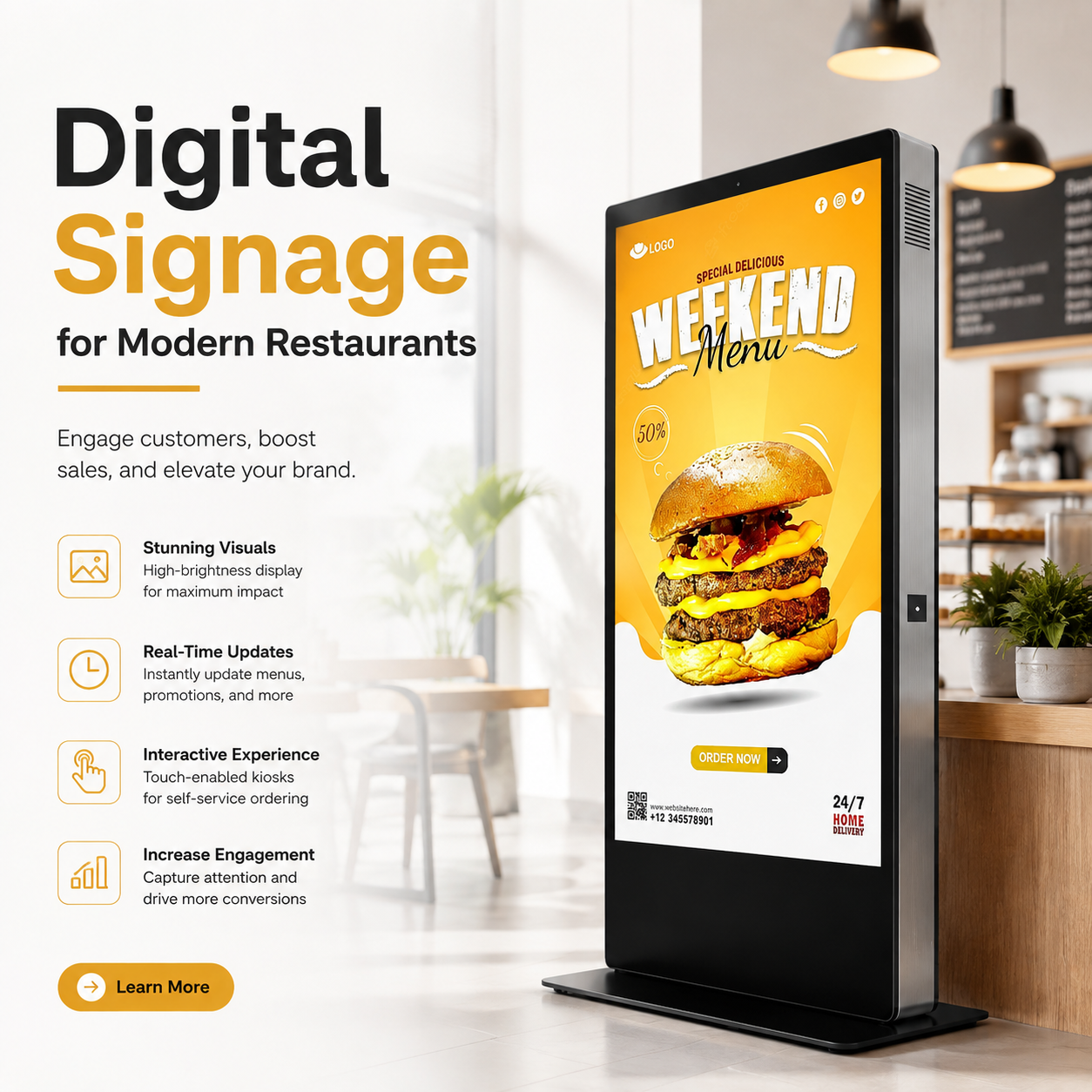
Every outdoor kiosk enclosure selection decision begins with one question: how much heat must the cabinet move, and can it stay sealed while doing it? The answer shapes the entire thermal budget. Two heat sources drive the design — solar radiation on the cabinet and internal heat rise from the high-brightness backlight and system-on-chip — and the choice is between open-loop air-cooled designs and sealed, closed-loop active HVAC.
What Drives Heat Inside an Outdoor Kiosk Enclosure
Heat inside an outdoor kiosk enclosure comes from two sources that act at once: external solar gain and internal component heat. Solar radiation heats the cabinet walls and the glass face regardless of what is running, while a high-brightness display, power supply, and processor raise the internal air temperature on their own. Once ambient air cannot remove that combined load, active methods rather than passive ones become necessary [4]. You cannot skip this baseline — your enclosure cooling strategy is only as sound as your estimate of the load it must reject.
For a practical vendor example, readers can review Industrial Touch Monitor Selection Guide: Optical Bonding, Sunlight Readability & Wide-Temperature Design · Wintouch.
Air-Cooled Thermal Design: Open-Loop and Passive Options
Air-cooled passive cooling outdoor digital signage enclosure designs move heat with airflow rather than refrigeration. Filtered fans draw outside air through the cabinet, while vented convection and air-to-air heat exchangers transfer heat across a sealed core. The trade-off: an open-loop filtered fan cools the outdoor kiosk enclosure by exchanging air, which compromises the IP/NEMA seal and can pull in dust and humidity. Heat exchangers stay sealed but can only cool internal air down toward ambient — never below it, since their heat-removal rate scales with the difference between cabinet and outside temperature [5]. For modest loads in mild climates, an air-to-air exchanger running on DC is a low-maintenance, back-up-friendly option.
Active HVAC: Sealed (Closed-Loop) Cooling and Heating
Closed-loop vs open-loop kiosk cooling is the central engineering fork. A micro DC air conditioner for outdoor kiosk enclosures uses a compressor and refrigerant to pull heat out of a fully sealed enclosure, so it maintains the IP rating and can cool below ambient — something vented designs cannot do [1]. Compressor-based units handle the heaviest loads; solid-state thermoelectric coolers suit smaller cabinets with modest requirements [3]. Integrated heaters add condensation prevention outdoor kiosk heating and cold-weather operation, because thermostatically controlled systems manage both heat and humidity to protect internal components [2].
The Thermal Design Equation: Solar Load + Internal Heat Rise
The outdoor enclosure solar load thermal calculation follows one equation: total heat load equals external solar gain plus internal component heat. The decision between a heat exchanger and an air conditioner then depends on the temperature delta, Tenclosure − Tambient [5]. If the design internal temperature stays above the hottest ambient temperature, airflow and an air-to-air exchanger suffice. If ambient can equal or exceed the internal set point — common in direct-sun deployments — only a sealed air conditioner can reject heat, because it removes load rather than merely transferring it down a temperature gradient. Compute the load before matching any cooler, since capacity follows the delta.
Climate-Zone Decision Matrix: When Each Approach Wins
Kiosk HVAC system selection by climate should follow the environment, not a vendor default. The matrix below maps conditions to the recommended approach.
| Climate | Temperature | Humidity / Solar | Recommended approach |
|---|---|---|---|
| Moderate | 60–80°F year-round | Low; fans only | Air-cooled fan / heat exchanger |
| Hot-arid | >100°F peaks | Low humidity, high solar | Full HVAC with compressor |
| Cold | Freezing winters | Low, but dew point risk | HVAC with integrated heater |
| Humid-coastal | Warm, high humidity | Constant moisture | Sealed HVAC + condensation control |
Ambient above the 60–80°F range means fans alone cannot hold internal temperature, and heating is required below it [2]. HVAC carries higher acquisition cost but longer reliability and far fewer field failures in harsh zones; heat exchangers win on DC power and longer maintenance intervals [5].
Sealing vs Venting: The Condensation Trade-Off
Condensation prevention outdoor kiosk heating matters most in fully sealed enclosures. When a cabinet is sealed to hold IP65 or NEMA 4, humidity trapped inside condenses at the dew point during temperature swings, damaging electronics and paper and rolls. Vented designs reduce condensation risk by exchanging air but trade that for ingress of dust and moisture. The resolution is active control: internal fans keep air moving, and heaters raise internal temperature above the dew point [2]. Choose vented to avoid condensation or sealed with humidity and heater management to keep the ingress rating — never assume either is free.
Total Cost of Ownership: Reliability and Service in the Field
Lifecycle cost favors the option with the lowest field-service burden. Closed-loop vs open-loop kiosk cooling trades upfront price against service calls: an air conditioner that fails or sheds refrigerant demands on-site MTTR and spare stock, while a passive heat exchanger is nearly maintenance-free over its life [5]. Remote temperature monitoring kiosk kits and thermostats cut MTTR by alerting before failures. Back-up power is decisive: full AC air conditioners are hard to back-up efficiently, whereas DC-driven units and heat exchangers ride a battery cleanly [5]. For procurement teams, a higher-priced DC HVAC often returns a lower total cost of ownership once maintenance and downtime are counted.
How to Choose: A Decision Checklist for Procurement Teams
Outdoor kiosk thermal management best practices reduce to a repeatable checklist. Define your climate zone and ambient extremes; compute the solar-plus-internal heat load and the Tenclosure − Tambient delta; decide open-loop versus closed-loop based on whether cooling below ambient is required; and factor in the ingress protection you need. A sealed ambient-level approach pairs naturally with a high-brightness display rated for direct sun — see our IP65 vs IP67 vs IP69K outdoor digital signage guide and the 1500-nits vs 2500-nits outdoor display comparison. Watch for the common miss: selecting an air-cooled cabinet before confirming ambient never exceeds the set point. When in doubt, have your engineering team model the solar load first, because a sound outdoor kiosk enclosure selection today saves a full swap-out tomorrow. For product details and project planning, see wintouchtech.com.
Content reviewed: 2026-08-06.
Evidence confidence
Confidence: Medium. This rating reflects cross-checking 5 sources across 5 independent domains. It measures evidence coverage, not certainty; verify safety-critical work against manufacturer instructions and local requirements.
References
APA 7th edition
- ↑Rigidchill. (n.d.). Micro DC Air Conditioner for Outdoor Kiosk Deployments. Retrieved August 6, 2026, from https://rigidchill.com/micro-dc-air-conditioner-for-outdoor-kiosk/.
- ↑Cited 3 timesFrankmayer. (n.d.). Do Outdoor Kiosks Require Heating and Cooling?. Retrieved August 6, 2026, from https://www.frankmayer.com/blog/do-outdoor-kiosks-require-heating-and-cooling/.
- ↑Tark Solutions. (n.d.). Thermoelectric Cooling for Outdoor Kiosks. Retrieved August 6, 2026, from https://tark-solutions.com/thermal-technical-library/application-notes/thermoelectric-cooling-outdoor-kiosks.
- ↑Atmmarketplace. (n.d.). Best Practices for Cooling Outdoor Kiosks. Retrieved August 6, 2026, from https://www.atmmarketplace.com/blogs/best-practices-for-cooling-outdoor-kiosks/.
- ↑Cited 5 timesElectronics Cooling. (n.d.). Thermal Management of Outdoor Enclosures, Part 3: Semi-Active Cooling Systems. Retrieved August 6, 2026, from https://www.electronics-cooling.com/2018/05/thermal-management-of-outdoor-enclosures-part-3-semi-active-cooling-systems.
You should also read:
How to Calculate Outdoor Digital Signage Brightness: 1500 Nits vs 2500 Nits Outdoor
Why a Simple Nits Number Fails for Outdoor Signage Choosing between 1500 nits vs 2500 nits outdoor digital signage looks like a spec-sheet decision, but a single brightness figure can’t carry it. The same 2,200-nit panel that stays legible under a covered transit hub will…
Continue reading...
IP65 vs IP67 vs IP69K outdoor digital signage: Selecting the Right Ingress Protection Rating for Outdoor Digital Signage
Ip65 Vs Ip67 Vs Ip69K Outdoor Digital Signage is the decision framework examined in this guide. The sections below turn sourced evidence into practical comparison criteria without overstating what the available research can prove. If you need a quick decision on IP65 vs IP67 vs…
Continue reading...